Stepping Back in Time: Little St Mary’s and Peterhouse


Our neighbourhood’s journey through the rich layers of Cambridge history continued this month with a fascinating visit to Little St Mary’s Church and Peterhouse. Guided by Yvonne, whose expertise in the Arts & Crafts and Victorian Gothic Revival movements brings these places vividly to life, we uncovered stories that span centuries of faith, architecture and student life.
Little St Mary’s: From medieval roots to Victorian Gothic Revival

Originally known as St Peter-Without-Trumpington-Gate, Little St Mary’s (aka St Mary the Less) began as a modest church outside the city walls, controlled by three successive generations of the same family before passing into the care of the Hospital of St John the Evangelist and eventually Peterhouse. Like many historic buildings, it has evolved continuously, with significant structural and decorative changes over time—particularly during the 19th century, when Arts & Crafts and Gothic Revival influences left their mark.
In the case of Little St Mary’s, we’re looking at a Victorian restoration, whereas our previous visits to Queens College and All Saints Church showed us new builds. In each case, though, these changes were influenced by two major trends: population growth and industrialisation. Between 1840 and 1911, Britain’s population expanded from 18.5 million to 42 million people, and the Industrial Revolution meant that, for the first time, the majority were living in cities. The Arts & Craft movement sought to maintain skills that were being lost through industrialisation, while the Gothic Revival was influenced by High Church ideals into reintroducing pre-Reformation practices and architecture. All this was supported by the newly wealthy industrialists.
Standing inside the church today, it’s striking to think that it predates the arrival of students to Cambridge in 1209.

Little St Mary’s is a treasure trove of artistic detail. The east window, designed by Charles Eamer Kempe, is a masterpiece—look closely for his signature wheatsheaf and the jewel-like detailing in the garments. Nearby, the work of Alfred Tombleson, one of F. R. Leach’s finest apprentices, can be admired; remarkably, only around 70 examples of his work survive nationwide, with two located here.
The church also features armorial glass panels representing Cambridge institutions, including Peterhouse, Trinity, the University and Ely Cathedral. Around the altar, a striking riddle post—reintroduced by Ninian Comper—adds an unusual medieval-style element.
Other highlights include the west window’s “Tree of Jesse,” tracing the lineage to Christ, and the Crucifixion window, another Kempe work with a distinct stylistic flair. Beneath it all lies Cambridge’s only church crypt, once used during times of plague, and even a hidden corridor linking directly to Peterhouse.
Behind the gates of Peterhouse
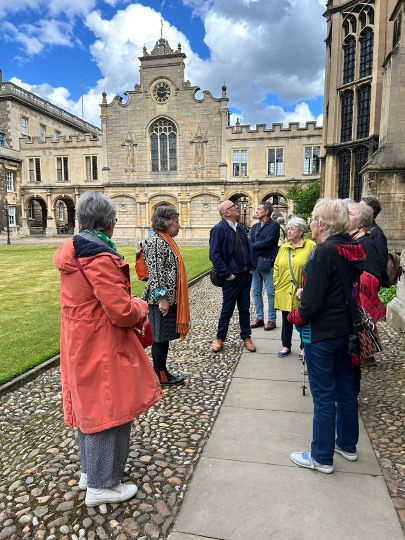
From the quiet intimacy of Little St Mary’s, we moved on to Peterhouse—the oldest college in Cambridge, founded in 1284 and still home to a small academic community with fewer than 300 undergraduates. Note, Peterhouse is the only Cambridge college not to use that word in its title.
In early days of the University, scholars lodged at St John’s Hospital but by 1284 Hugh de Balsham, Bishop of Ely, found that the sick and the students could not live in harmony together and the students were relocated to terraced houses on the site of what is now Peterhouse; this was the origin of the first Cambridge college. For centuries, Little St Mary’s served as the college chapel, only reverting to a parish church in the 1630s under Matthew Wren, uncle to Christopher whose first church design was Pembroke College’s chapel across the road.

The Hall, dating back to the 13th century, is the oldest part of the college and offers a glimpse into medieval collegiate life. Its 19th-century redecoration, guided by George Gilbert Scott and completed by William Morris and F. R. Leach, transformed it into a showcase of Arts & Crafts design. The painted walls, created using the traditional “prick and pounce” technique, and the stained glass windows produced by Morris’s workshop, are particularly striking.
The Combination Room—formed by Gilbert Scott's merging of two earlier parlours—features beautiful Burne-Jones windows illustrating Chaucer’s Legend of Good Women. It also carries echoes of student life through the centuries, including the tale of one unfortunate student, Thomas Grey, whose fear of fire led to him being tricked into leaping from a window into a vat of water; after that, he promptly transferred to Pembroke College.

Peterhouse has long been a place of innovation as well as tradition. Alumni include Lord Kelvin, who funded the installation of electricity—making it Pembroke of the first places outside the Palace of Westminster to be electrified—as well as pioneers like Frank Whittle (the jet engine) and Christopher Cockerell (the hovercraft).
Despite its age, Peterhouse remains a vibrant academic community, with traditions such as formal halls, which Peterhouse’s undergraduates have to attend at least weekly. Its gardens, once part of a 19th-century deer park, now provide a peaceful retreat behind the Fitzwilliam Museum.
This visit was a reminder of how deeply intertwined Cambridge’s religious, academic and social histories are. From medieval parish life to Victorian revivalism, from craftsmanship to innovation, Little St Mary’s and Peterhouse together tell a story of continuity and change.
As always, Yvonne’s insights helped us see beyond the surface—revealing not just buildings, but the people, movements and ideas that shaped them.
We look forward to our next exploration of Cambridge’s remarkable past.


Comments