Memory, silence and regret: Book Club discusses "So Long, See You Tomorrow"

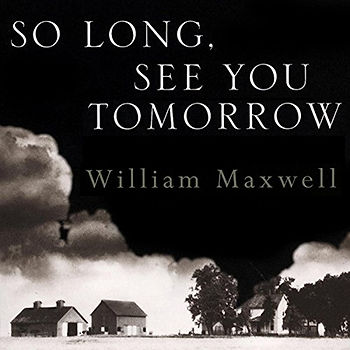
We had a good turnout at Hanami on Tuesday 10th February. Ruth introduced So Long, See YouTomorrow by William Maxwell, whom she has admired for a long time. He had a stellar literary career, being The New Yorker's literary editor from 1936 to 1975 and working with too many famous writers to list here. He wrote essays, short stories, children's books, a memoir and six novels.
This book is a sequel to They Came Like Swallows (which Book Club read in 2020) but their publications were separated by more than 40 years (1937 to 1980). The earlier novel tells of a 10-year-old boy whose mother dies in 1918 from the Spanish flu epidemic, days after the birth of her third son, and of his father's inability to even begin to meet the devastated child's needs. It was largely autobiographical, as Maxwell's mother died in this way, though the locations and the fathers' careers are different.
So Long, See You Tomorrow returns to the same rural community when the narrator is about 13. It starts with a murder of a farmer by his neighbour following an affair between the neighbour's wife and the victim. Dramatic though this is, the murder isn't the main plot focus. Instead, we follow several families and their often strained relationships. The narrator's close (perhaps only) friend, Cletus, is also affected by the murder, though being teenage boys in the 1920s they never talk about anything except sports and fishing.
The families move apart, and later, when the boys are about 15, they pass each other by chance in a school corridor. The narrator wants to say something to Cletus but has no idea what to say, and the moment is lost. They never meet again and we gradually discover that the narrator guiltily regrets this lost opportunity for the rest of his life.
The themes are wide-ranging: guilt; moral responsibility and regret; loneliness and isolation, particularly in rural communities where people may find themselves entering a marriage that neither really wants much; the fallibility of memory (such that "most memories are lies"); childhood suffering and the inability of many adults to recognise and comfort it; and the tendency of some people to react to pain by violence. Patrick pointed out some similarities with Melvyn Bragg's writings about rural Cumbria.
Maxwell himself believed that people can't be separated from their circumstances and that silence can cause great harm. In both this novel and its predecessor, silence has lasting consequences - the father's silence with his children after the death of his wife, and the lost chance to say something in the corridor. Indeed, in rural Illinois in the 1920s, almost nobody seems to be able to articulate anything emotional, painful or difficult.
The book is beautifully and sparingly written, and has been included in a list of the 100 most influential novels of the twentieth century. Without doubt, the issues and themes are powerful and moving. A few of us cautiously admitted that we had found it hard to remember who all the characters were, and others were relieved to agree that they had too. So we wondered if the author deliberately didn't distinguish the characters in a more memorable way, as he surely could have. Perhaps he left them rather vague to remind us that the young narrator writes many years later, and we read, with gappy memories. I found online a reviewer who admitted all the admirable features of this book but couldn't help finding it "bloodless", and we could all see what he meant. There was certainly lots to discuss, and as you see I haven't been able to write a snappy account!
Next meeting: Tuesday, 10th March - James by Percival Everett.


Comments